

Every buyer evaluating voice AI eventually asks the same question. What happens when this runs at real volume, on real traffic, at our peak? A demo proves the agent can hold a conversation. It proves very little about a day carrying 57,000 calls, a caller who switches from English to Gulf Arabic mid-sentence, or a CRM that starts rate-limiting at 4pm.
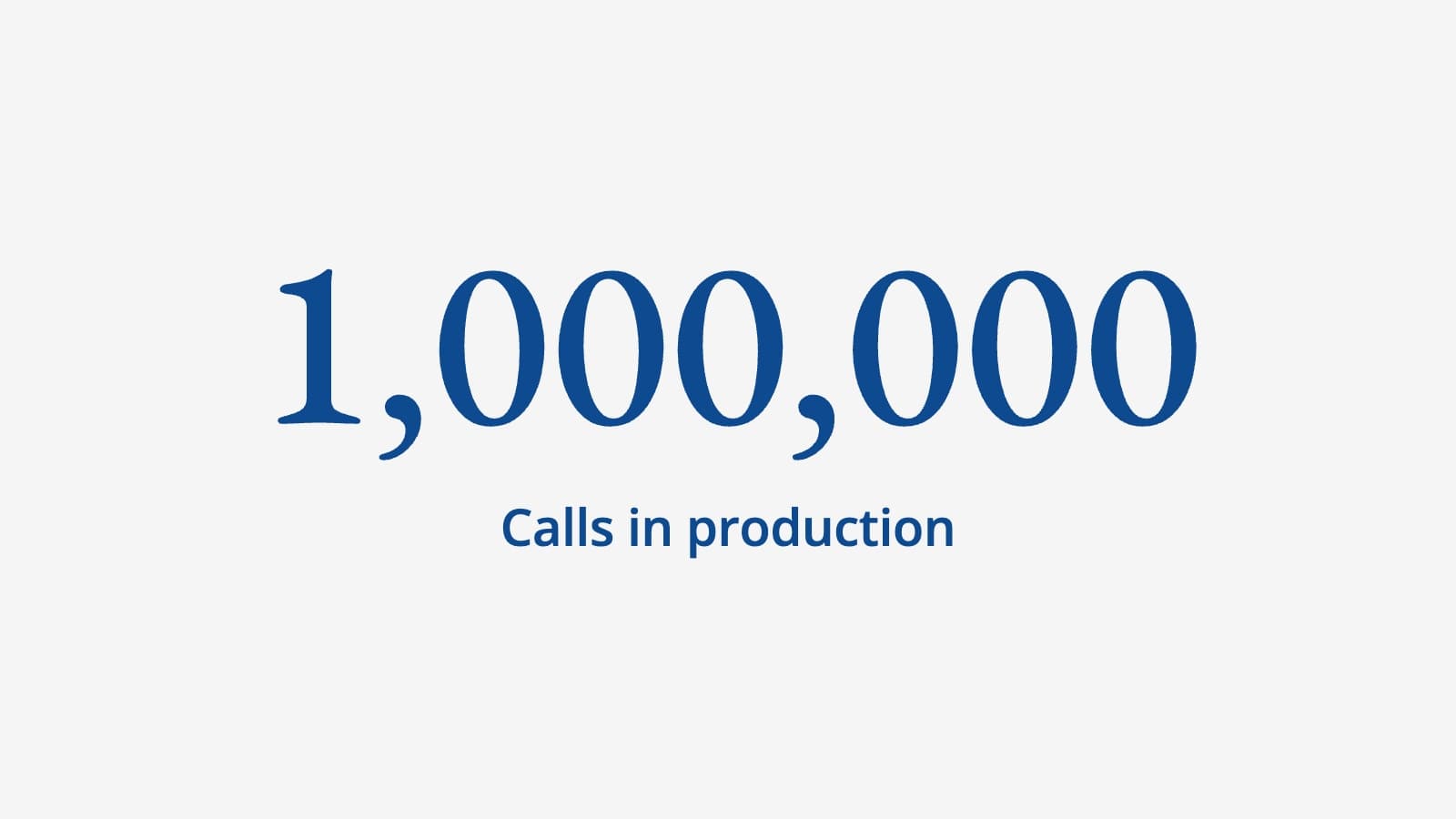
By August 2026, xAIa's AI employees had handled more than 1,000,000 production calls, with routine volume above 600,000 calls a month, a record month of 750,000 and a record day of 57,000, across 63+ AI agents working in 90+ languages. The record covers live deployments only, inbound and outbound, in the Gulf and outside it, for utilities and energy, insurance, real estate, healthcare, government, after-sales service, logistics and retail. The largest single deployment, a UK energy brokerage, carried 350,000+ calls a month at 100 concurrency, on three AI employees sharing one operational layer: renewals, data cleansing and onboarding. Response latency across those deployments ran at about 500ms.
Six findings came out of that record. Each one is about running the operation, because the conversation layer held at every volume we ran it at, and the work lived everywhere else.
1. What it takes to run voice AI as infrastructure
A voice AI agent at scale is a telephony workload first. Before the first production call, xAIa maps the trunk contract, the channel and call-setup caps, the codec the operator delivers, the demarcation point and the caller ID entitlement, because every one of those becomes a ceiling on the agent. The four routes to a UAE number each carry their own provisioning clock, and the operator's clock is the item most often on the critical path, so the order goes in during week one.
Region is the second decision. Every turn of a call crosses the media path twice, so the speech, the model and the edge sit in region, and where a mandate requires it the whole stack runs on-premise, with voice that never leaves the customer's infrastructure. Failover is designed for the middle of a call, where a re-established leg hands the agent a working audio path and nothing else unless session state was held outside it. Under sustained degradation the agent says so and hands the call to a human.
2. How xAIa manages concurrency
Concurrency is the number of conversations happening at once, and the agent side does not cap it. An AI employee finishes a call, writes the outcome to the CRM inside the call, and takes the next one. No wrap-up, no break, no roster.
The infrastructure scales concurrency without a ceiling of its own. Whatever a customer asks for, ten conversations or a thousand, is a provisioning decision rather than a platform limit. The real ceiling sits on the telephony: the number of channels on the trunk, how fast the operator allows new calls to start, and how many numbers the customer holds to dial from. A trunk has no queue, so the call above the ceiling is rejected, and a setup-rate breach returns a 503 that looks nothing like a capacity problem.
Underneath, the infrastructure handles four things.
- Capacity-aware dispatch. It reports remaining concurrency on demand, so a campaign checks available capacity before releasing a batch rather than discovering the ceiling by hitting it.
- Reserved inbound headroom. Outbound is paced below both caps with a share of the trunk held back, so a campaign never busies out a customer calling in.
- Caller identity rotation. Outbound dials from defined number groups, matching the caller's country where that improves answer rates and spreading volume across numbers rather than burning one.
- Campaign scheduling inside the legal window. Cabinet Resolution No. 56 of 2024 permits telemarketing from 09:00 to 18:00 under Article 5(3), compressing a day of outbound into nine hours. Campaigns spread across the window, retries land in its quieter hours, and callbacks fire at the time the customer chose.
Concurrency, setup rate and operator rejection codes are watched live, so a cap is raised with the operator before it is reached.
Scale then comes from adding agents to the same layer rather than seats to a floor. The largest deployment runs three AI employees on one operational layer at 100 concurrency and 350,000+ calls a month, each inheriting the telephony, pacing and integrations the first one proved.
3. Monitoring every call with ComplAI
Sampling two percent of calls finds the problems that are common. It cannot find the ones that are rare, expensive and specific. ComplAI reviews 100% of recorded conversations against the client's scripts, regulations and quality standards, scores every interaction and writes an audit log for each one. That is the class of failure it exists to catch: a disclosure delivered late, an agent drifting from the approved script after a prompt change, a question callers keep asking that the agent has no tool for.
Findings route two ways. Individual calls escalate to the compliance function on the channel the client chose, with the recording, the transcript and the flagged clause attached. Patterns feed back into the agent build, where a failure found in review becomes a fixed prompt, a new tool or a routing rule, tested against the calls that exposed it before it goes live. Reviewing everything is what turns a compliance cost into the feedback loop the operation runs on.
4. Access rights, and structured data back into your systems
Every agent has an explicit scope on the infrastructure, set per client and per role: which systems it may read, which fields it may write, which actions it may complete alone, and where it must hand to a person. The agent can call the tools the infrastructure exposes to it and nothing else. Every action is logged with what was read, what was written and the reason, and each call carries an identifier that retrieves its status, recording and transcript on demand. A compliance team can replay any call end to end. That is what lets a bank or a government entity put an AI employee on a live line.
The value of a call sits in the seconds after it ends. The same infrastructure turns each call into structured output against a defined schema, so the shape of the data is fixed in advance and versioned rather than inferred afterwards. The outcome is tagged, the fields updated, the next action queued, with the transcript and recording stored alongside. Across xAIa's deployments that means tickets raised, appointments written into calendars, leads scored and assigned, orders placed against live inventory, and CRM and ERP records updated in the same shape a human colleague would have left them. Those writes run through Agent API, xAIa's own integration layer, which follows each client's screens, fields and rules. Operations teams read those records in the dashboards they already open every morning, which is where the actionable insight arrives: which campaigns convert, which questions recur, and where the humans are needed.
5. Campaigns, callbacks, analytics, and where the savings come from
The infrastructure runs the calendar as well as the calls. Outbound campaigns are loaded with their scope, their calling window, their retry rules and their suppression lists, with Do Not Call screening enforced at the platform so a suppressed number cannot be dialled even by mistake. A caller who asked to be called back gets the callback at the time they chose, from the same agent with the same context. Renewal cycles, payment reminders and appointment confirmations run as scheduled workloads, and the after-hours line answers at the same speed at 2am as at noon.
Every campaign reports into the same analytics: connect rate, outcome mix, escalation rate and the reasons behind it, cost per completed outcome. The saving comes from three places at once. Coverage extends to every hour without a night shift. Volume grows without adding a seat, because the second and third agents on a deployment inherit the telephony, retry logic and integrations the first one proved. And the review layer removes the sampling gap, so compliance exposure that used to sit undetected inside live calls is found the day it happens.
6. Edge cases and pattern catching
A million calls surfaces what no pilot does. Instructions have to sit at the point of decision, because an agent that must look three sections up its own prompt invents something instead. A tool call has to fire in the same turn as the sentence announcing it, or the caller hears silence and hangs up. Language following has to govern every branch of the flow, because callers open in English, switch to Arabic mid-sentence, and expect to be followed without asking. And escalation has to carry the full context, since a customer repeating their story to a human after speaking to an AI is worse than never having deployed one.
The patterns are caught the same way the compliance failures are. The review layer flags the outliers, the transcripts show the shape of the failure, and the fix ships as a prompt change, a new tool or a routing rule, then runs against the calls that exposed it before it goes live. Because agents are versioned, that fix is a release with a number on it rather than an edit nobody can trace.
A million calls taught us where the work lives. The conversation held at every volume we ran it at. What decided each deployment was the trunk it answered on, the pacing of its concurrency, the review of every call it made, the scope around what it could touch, and the structured record it left behind. Those five are what xAIa builds, and they are why the second and third agents on a deployment go live faster than the first.
~ Team xAIa
Frequently asked questions
How many calls has xAIa handled in production?
More than 1,000,000 production calls by August 2026, with routine volume above 600,000 calls a month across 63+ AI agents, a record month of 750,000 calls and a record day of 57,000.
What breaks first when voice AI runs at scale?
The telephony ceiling. The infrastructure scales concurrency on request, so the hard limits are the trunk's channel count, the operator's call-setup cap and the numbers held to dial from, and they need to be contracted and monitored before the agent is switched on.
How does xAIa monitor the calls its agents make?
ComplAI reviews 100% of recorded conversations against the client's scripts, regulations and quality standards, scores each one and writes an audit log. Individual failures escalate to the compliance function with the recording and the flagged clause attached; patterns feed back into the agent build.
What data does an AI agent return after a call?
Structured output against a defined, versioned schema: the outcome tagged, the CRM or ERP fields updated, the ticket or appointment created, and the next action queued, with the recording and transcript retrievable by the call's identifier. Access to those systems is granted per agent and per role, with every action logged.
Can AI agents run outbound campaigns in the UAE overnight?
Telemarketing calls in the UAE are restricted to 09:00 to 18:00 under Cabinet Resolution No. 56 of 2024, Article 5(3). Inbound lines, callbacks the customer requested and service notifications outside that scope run around the clock, and the clause-by-clause version is in the UAE AI call center guide.
How long does it take to reach production volume?
xAIa's deployments typically run 30 days from pilot to live, then 30 days of hypercare. Telephony provisioning runs on the operator's clock and is the item most often on the critical path.
Speak to us and we will show you what an AI employee handles in its first week.