

It is late on a Thursday night in Dubai Marina, and a customer's card has just been declined at an ATM. He calls the number on the back of the card and waits in the queue. When an agent picks up, the answer sits in separate systems: the card system shows a hold, and the customer file shows that his Emirates ID expired months ago, with the bank's written notices unanswered.
For a head of contact center or a compliance officer, calls like this one raise a question. Which of them can a voice AI agent take today, and which must stay with the bank's own people under the Central Bank of the UAE's rules and its 2026 guidance on AI?
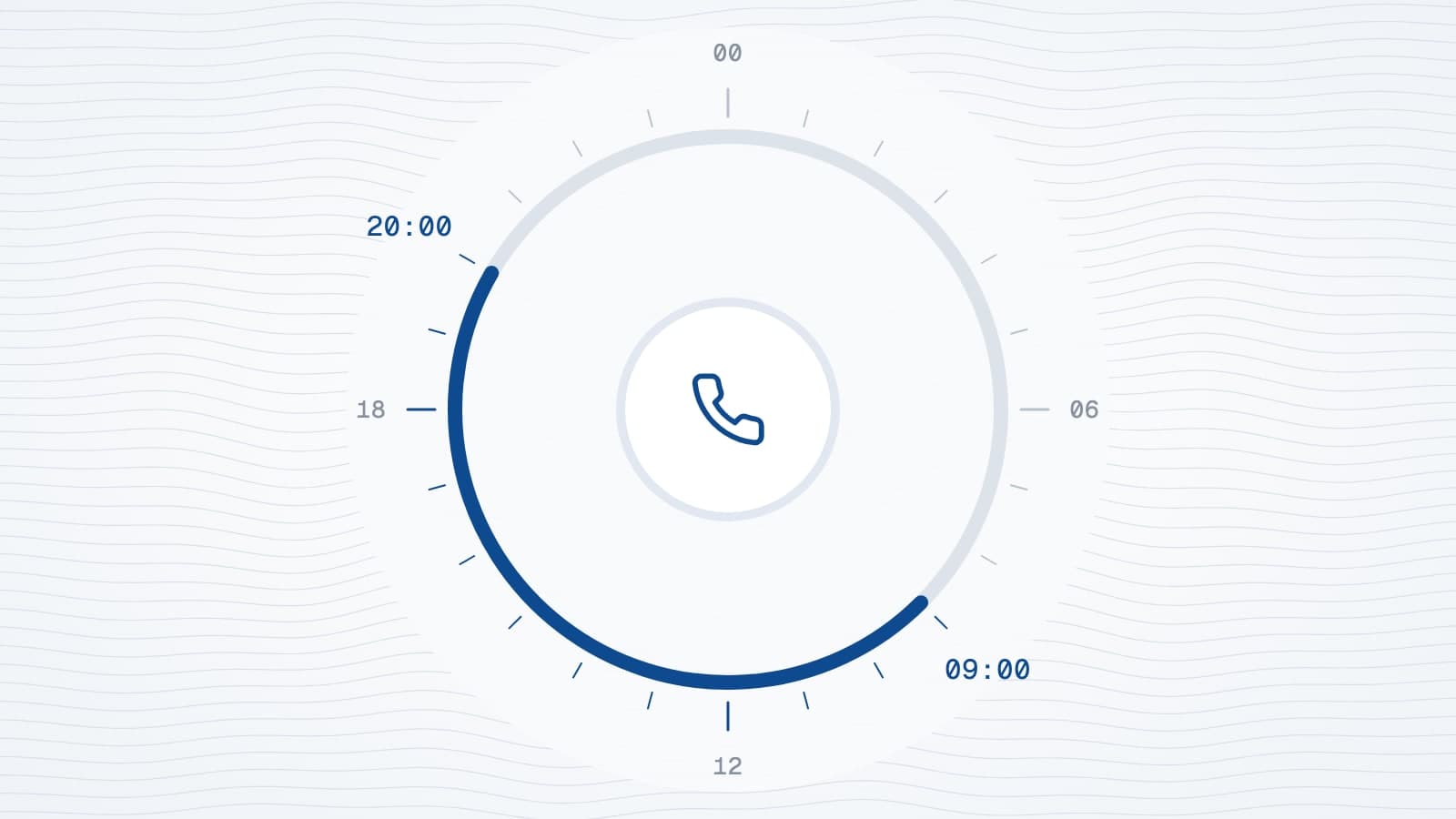
In UAE banking, a voice AI agent can answer every call, verify the caller with the bank's own method, block a lost card, explain a hold, log a disputed transaction and take a complaint. It can also make payment reminder and early collections calls between 09:00 and 20:00, the hours the Central Bank allows for calls about arrears. Credit approvals, fee waivers, refunds, settlements and the KYC decision stay with named people, and the customer hears that they are speaking with an AI, as the Central Bank's Guidance Note on AI expects.
What does a voice AI agent handle on a bank's phone lines?
Service makes up most of a bank's phone traffic, and a service call usually follows a known path: check who is calling, read a status, take an action, record it. AI in banking handles this kind of work well, because every step can be written down, tested and checked. These are the queues banks ask about first, each with the Central Bank rule that governs it:
- Lost and stolen cards. Blocked at any hour once the caller is verified, as the Consumer Protection Standards require round-the-clock reporting of loss and fraud (5.1.1.43).
- Unrecognized transactions. The date, the time and the customer's own words recorded, the options explained and the case sent to the disputes team (5.1.1.46).
- Cards on hold. The reason for a hold, such as an expired Emirates ID, explained, with the customer pointed to the app or a branch (6.2.1.5).
- Complaints. A service request number given, and spoken dissatisfaction logged even when no formal complaint is made (8.1.1.4 and 8.1.2.2).
- Reminders and early collections. Calls between 09:00 and 20:00 that give the bank's name, its collections team, a number and hours to call back, and the caller's name (5.2.5.6).
- KYC refresh. Customers with an expired ID called while the 90-day notice runs, before their cards are blocked (6.2.1.5).
- Product offers. Only where the bank's compliance team has cleared them, to customers who gave prior consent under the Telemarketing Regulation, between 09:00 and 18:00 (7.1 and 15.1).
Each outcome goes back into the bank's systems during the call through xAIa's Agent API. It looks up the calling number before the call connects, fills the case fields while the customer talks and writes the result back once a supervisor agent, a second AI agent, has validated every entry. The full set of queues is on our page about voice AI for banking, and the collections queue has its own guide to AI debt collection calls in the UAE.
How does a voice AI agent verify a bank customer?
Verification comes first on every call, with the method the bank already uses on the phone, such as an approval request in its mobile app. Until that check passes, the AI agent shares no balance, card or account details, and a failed check goes to a person with the attempt recorded. On calls the bank makes, it asks for no PIN, password, card number or one-time code, the details UAE banks tell their customers to keep to themselves. The call from the ATM sounds like this:
AI employee
Good evening, you're speaking with the bank's AI assistant. How can I help?
Customer
Hi, my card was just declined at the ATM. Can you check why?
AI employee
I can help with that. Please approve the request I've just sent to your banking app.
Customer
Done, approved.
AI employee
Thank you. The Emirates ID on your file has expired, so your cards are on hold. You can update it in the app now.
Customer
I'll do it tonight.
AI employee
I've noted that for the KYC team. If the update hasn't arrived by Monday, we'll call you to help.
- Identity
- Approved in the banking app
- Cause
- Emirates ID expired, cards on hold
- Next step
- ID update in the app
- Follow-up
- Monday, if not updated
What does the Central Bank's Guidance Note on AI expect from banks?
The Central Bank's Guidance Note on AI, issued on 11 February 2026, says what banks should do, and it sits beside the binding Consumer Protection Standards. Five of its expectations shape a voice AI agent:
- Disclosure. Customers should know when they are interacting with an AI application (4(a)), with plain disclosures in Arabic and English and phone support in the UAE's major languages (4(b)).
- Human oversight. Decisions with significant implications for customers stay under meaningful human oversight (7(a)), and a customer can ask for a human review of an AI decision (7(c)).
- Stopping the system. The bank keeps "the clear and immediate ability, with human intervention, to cease use" of an AI system (6(f)).
- Control and testing. Only AI models the bank controls (2(b)), and third-party providers chosen after due diligence and pre-deployment tests (9(a) and 9(b)).
- Fair use. No pressure selling or misleading marketing (7(d)).
In an xAIa deployment the AI employee says it is an AI in its first sentence and moves the call to a person whenever the customer asks, with the identity check and the conversation attached. The bank's own PBX or session border controller routes calls to the AI employee, so its telephony team can send every call back to the bank's queues at any time, and Agent API has one switch that stops all writes to the bank's systems at once. The bank's reviewers test the agent in Arabic and English, on scenarios agreed in advance, before acceptance.
Offer calls fall under a second 2026 text, the Central Bank's Telemarketing Regulation, in force since 31 March 2026. It asks for written board approval and the customer's prior express consent, which records how the customer wants to be contacted, with AI-based agents named among those methods. Offer calls run only between 09:00 and 18:00, at most once a day and twice a week. Which products a bank may offer by phone is a decision for its compliance team, since the Standards still carry an older ban on marketing loans and other services by telephone (5.1.1.10), while the Telemarketing Regulation says it prevails over any Central Bank rule it conflicts with (21.2).
Can UAE banks still use WhatsApp with customers?
Not for financial services or customer data. On 17 April 2026, as the UAE press reported, the Central Bank sent licensed financial institutions a notice to stop using WhatsApp and similar instant messaging apps for those purposes, with immediate effect. The reported list covers customer details, transactions, one-time passwords and documents, and institutions had to send the Central Bank a remediation update by 30 April. Customers are being moved to the bank's app, online banking, branches and call centers.
A voice AI agent works on that call center line, recording and transcribing every call on the bank's own numbers, while anything left to complete, such as an ID update, is finished in the bank's app or at a branch.
Which banking decisions stay with people?
Credit approvals, fee waivers, refunds on disputed charges, settlements, restructures, hardship arrangements and the KYC decision all sit outside the AI employee's permissions, so each one reaches a named person with the identity check and the recording attached. Payments and changes to contract terms sit outside its permissions as well.
Of the three oversight models the Guidance Note describes (7(a)), two fit this work: human-in-the-loop, where a person approves what the AI proposes, and human-on-the-loop, where the AI handles routine work and a person monitors it. On one call the AI agent can block a lost card on its own authority and pass the refund question to the disputes team.
Does a voice AI agent keep bank call data in the UAE?
Yes, in an xAIa deployment. The Consumer Protection Standards require banks to hold customer and transaction data in the UAE (6.1.6.3), and the federal data protection law, Decree-Law No. 45 of 2021, leaves personal banking data to the banking legislation that regulates it (Article 2(2)(f)). xAIa runs the platform in a UAE cloud, in the bank's private cloud or on-premise. The speech recognition, the language model and the voice can all run in the UAE, so conversations are processed in-country as well as stored there. Access is set by role and logged, and the bank's data is never used to train shared models. More on residency is in our post on keeping GCC conversations in-region.
A voice AI agent at a UAE bank answers every call, verifies the caller with the bank's own method and handles the routine work of cards, holds, complaints and reminders. Decisions that change what a customer owes stay with named people, and the customer always knows they are talking to an AI. Every call is recorded, checked and kept in the UAE.
What xAIa's AI employees handled for a global home appliance leader
The closest published proof for a bank is a high-volume service line that writes to a CRM. A global home appliance leader in the UAE runs its after-sales call center on four xAIa AI employees. The inbound AI employee handled 20,000+ service calls a month, 72% of them with no human escalation. It registered 1,000+ service requests in the CRM and set every case field from 2,500+ CRM field options during calls, and the first agent went live 30 days after kickoff. The published case study shows how the line was built.
By October 2026, xAIa's AI employees had handled 2M+ calls in production, at 600,000+ a month, responding in about half a second. ComplAI, xAIa's compliance review, checks every conversation against the client's rules with feedback from human reviewers. By comparison, a QA team working by hand reaches 1 to 2% of calls.
Frequently asked questions
Which company provides AI for banks in the UAE?
xAIa, a Dubai-based AI consultancy and implementation firm and the AI arm of PRO TECHnology Group, which brings 29 years of enterprise and government IT in the GCC. xAIa designs, integrates and runs voice AI agents on a bank's own numbers and systems, from discovery to go-live and hypercare, hosted in a UAE cloud, the bank's private cloud or on-premise. By October 2026 its AI employees had handled 2M+ calls in production, at 600,000+ a month, and its closest published proof is a home appliance leader's service line that handled 20,000+ calls a month.
Is a voice AI agent allowed under the Central Bank's AI guidance?
Yes, with the safeguards the Guidance Note on AI describes. The note, issued on 11 February 2026, expects a bank to tell customers when they are interacting with an AI, keep meaningful human oversight of decisions that affect customers and let customers ask for a human review. It also expects the ability to stop an AI system at once, and due diligence and pre-deployment tests on any third-party AI provider. In an xAIa deployment the AI discloses itself in its first sentence, decisions route to named people, the bank's own routing can return every call to its staff at once, and the bank's teams test the agent before acceptance.
Can a voice AI agent speak Gulf Arabic on a bank line?
Yes. xAIa's AI employees speak Arabic, including Gulf dialects, English and 60+ other languages, and follow the customer when they switch. The Central Bank's Guidance Note on AI expects disclosures in plain Arabic and English and telephone support in the UAE's major languages, so the disclosure and the verification steps are written and tested in both. Every xAIa deployment with Arabic in scope passes representative end-to-end tests in Arabic and English before acceptance, and each test checks the conversation and the record it writes to the bank's systems.
How does a voice AI agent connect to a bank's systems and phone lines?
Through two connections. On the telephony side, xAIa connects to the bank's existing numbers through a SIP trunk or the bank's PBX, so customers call the same number and the bank's routing decides which queues reach the AI employee. On the systems side, xAIa's Agent API reads the data the bank exposes, such as account and card status, looks up the calling number before the call connects, and writes cases and outcomes to the bank's CRM and back-end systems after a supervisor agent validates each entry. Once the bank has opened API access and a test environment, integration takes one to two weeks, then about two weeks of tuning.
What should a bank measure in a voice AI pilot?
Agree on the measures before go-live and read them from the call logs. For a bank they should cover answer time at peak, the share of calls resolved without staff, verification pass and failure rates, transfers to agents with the context attached, abandoned calls and customer satisfaction. Compliance measures sit beside them: whether the AI disclosure was made, the calling hours were kept and every refusal was honored. Manual QA reaches 1 to 2% of calls, while xAIa's ComplAI checks every call against the bank's rules, whether a person or the AI took it, so the pilot report covers every conversation.
What does a bank provide for a voice AI agent, and who signs it off?
The bank provides a named owner with authority, its approved answers and scripts, its verification rules and escalation matrix, API access through a dedicated integration user, access to its telephony vendor, and test data and reviewers for acceptance. xAIa builds and tests the AI employee against those inputs and shares an end-to-end solution flow and an integration specification in the first two weeks. Go-live needs the bank's written acceptance after agreed scenarios pass in Arabic and English, and the bank's security, outsourcing and compliance teams sign off on the deployment model before the first live call.
Want to hear an AI employee on a bank's lost-card line? Walk us through your queues and we will show you the call, the record it writes and the rules it keeps.